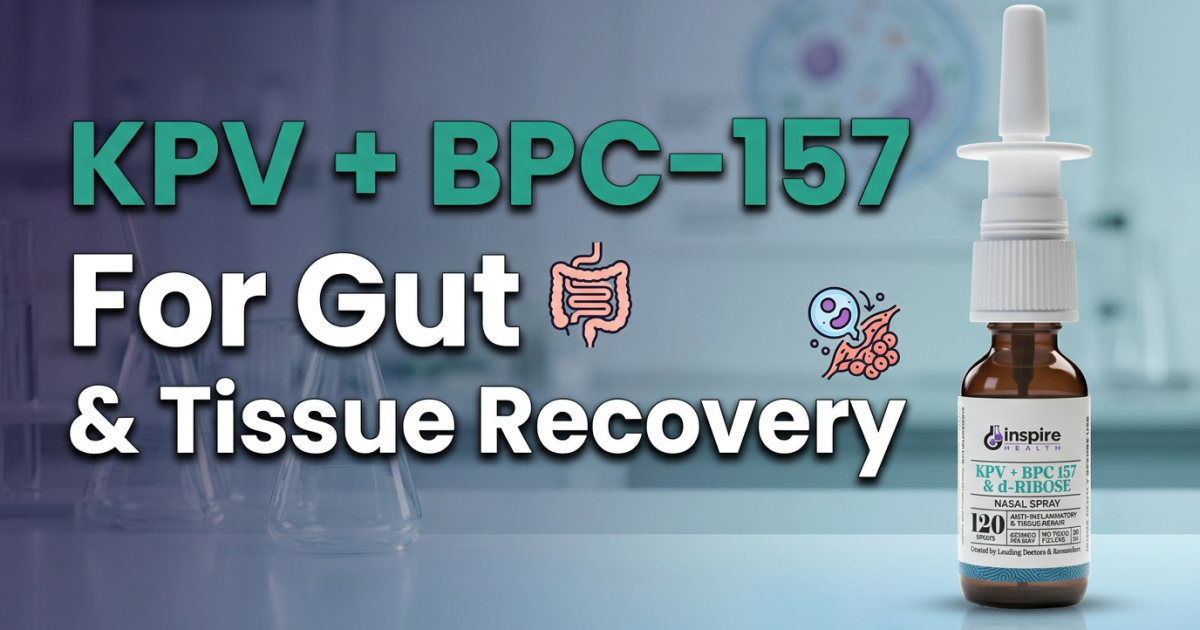
If BPC-157 is the construction crew that rebuilds damaged tissue, KPV is the fire department that puts out the inflammation first. Together, they address the two fundamental requirements of any healing process: stop the damage, then repair what’s broken.
This combination has become one of the most requested peptide protocols in the recovery and gut health space — and the research behind each component explains why.
What Is BPC-157?
BPC-157 (Body Protection Compound-157) is a 15-amino-acid peptide derived from a naturally occurring protein in human gastric juice. It was first identified and characterized by researchers studying the protective mechanisms of the gastrointestinal tract. Since then, it has become one of the most extensively studied peptides for tissue repair across multiple systems.[1]
BPC-157’s Mechanisms
Angiogenesis: BPC-157 promotes the formation of new blood vessels, which is essential for delivering oxygen and nutrients to damaged tissue. Research published in Journal of Physiology-Paris demonstrated that BPC-157 significantly accelerated blood vessel formation in injured areas.[2]
Growth Factor Modulation: Studies show that BPC-157 upregulates several growth factors involved in tissue repair, including VEGF (vascular endothelial growth factor) and the FAK-paxillin pathway, which governs cell migration to wound sites.[3]
Gastrointestinal Protection: As a peptide originally isolated from gastric juice, BPC-157 has particular affinity for the GI tract. Research has demonstrated protective effects against various forms of gastrointestinal damage, including NSAID-induced lesions, inflammatory bowel conditions, and anastomosis healing.[1]
Nitric Oxide System: BPC-157 interacts with the nitric oxide (NO) system, which plays critical roles in vascular function, inflammation regulation, and tissue homeostasis. This interaction appears to be bidirectional — BPC-157 can normalize NO levels whether they’re pathologically elevated or suppressed.[4]
What Is KPV?
KPV is a tripeptide (Lys-Pro-Val) derived from alpha-melanocyte-stimulating hormone (α-MSH). While α-MSH is known primarily for its role in skin pigmentation, its C-terminal fragment KPV retains the potent anti-inflammatory properties without the pigmentation effects.[5]
KPV’s Mechanisms
NF-κB Inhibition: KPV’s primary anti-inflammatory mechanism involves inhibiting the NF-κB signaling pathway — one of the master regulators of inflammatory gene expression. By entering cells and directly interacting with NF-κB, KPV suppresses the production of pro-inflammatory cytokines including TNF-α, IL-1β, and IL-6.[5]
Mucosal Anti-Inflammatory Effect: Research published in the Journal of Biological Chemistry demonstrated that KPV has direct anti-inflammatory effects on intestinal epithelial cells. In models of intestinal inflammation, KPV reduced inflammatory markers and protected mucosal barrier integrity.[6]
Immune Cell Modulation: Studies show KPV can modulate the inflammatory behavior of macrophages and other immune cells, shifting them from a pro-inflammatory (M1) phenotype toward an anti-inflammatory (M2) phenotype — essentially redirecting the immune system from damage mode to repair mode.[7]
Why the Combination Works
Tissue recovery is a two-phase process. Phase one is resolving inflammation — you can’t rebuild a house while it’s still on fire. Phase two is the actual repair and regeneration of damaged tissue. KPV handles phase one. BPC-157 handles phase two. Together, they create the conditions for efficient, complete recovery.
This is particularly relevant for gut health, where chronic low-grade inflammation (driven by food sensitivities, stress, medication use, or dysbiosis) damages the intestinal lining and perpetuates a cycle of inflammation and permeability (“leaky gut”). KPV addresses the inflammatory component while BPC-157 supports the structural repair of the intestinal epithelium.
The Role of D-Ribose
D-Ribose is a naturally occurring sugar that serves as a building block for ATP synthesis. Damaged cells have depleted energy stores, and D-Ribose provides the raw material for ATP regeneration — essentially giving recovering cells the fuel they need to complete the repair process. Research has demonstrated that D-Ribose supplementation significantly accelerates ATP recovery in stressed tissues.[8]
References
- Sikiric P, et al. “Stable gastric pentadecapeptide BPC 157: novel therapy in gastrointestinal tract.” Current Pharmaceutical Design. 2011;17(16):1612-1632.
- Seiwerth S, et al. “BPC 157’s effect on healing.” Journal of Physiology-Paris. 1999;93(6):441-444.
- Hsieh MJ, et al. “BPC 157 enhances the growth hormone receptor expression in tendon fibroblasts.” Molecules. 2017;22(3):529.
- Sikiric P, et al. “The pharmacological properties of the novel peptide BPC 157.” Inflammopharmacology. 1999;7(1):1-14.
- Brzoska T, et al. “Alpha-melanocyte-stimulating hormone and related tripeptides: biochemistry, anti-inflammatory and protective effects.” Endocrine Reviews. 2008;29(5):581-602.
- Dalmasso G, et al. “The PepT1-transportable tripeptide KPV reduces intestinal inflammation.” Journal of Biological Chemistry. 2008;283(47):32332-32340.
- Kannengiesser K, et al. “Melanocortin-derived tripeptide KPV has anti-inflammatory potential in murine models of colitis.” Inflammatory Bowel Diseases. 2008;14(3):324-331.
- Hellsten Y, et al. “Effect of ribose supplementation on resynthesis of adenine nucleotides after intense intermittent training.” American Journal of Physiology. 2004;286(1):R182-R188.