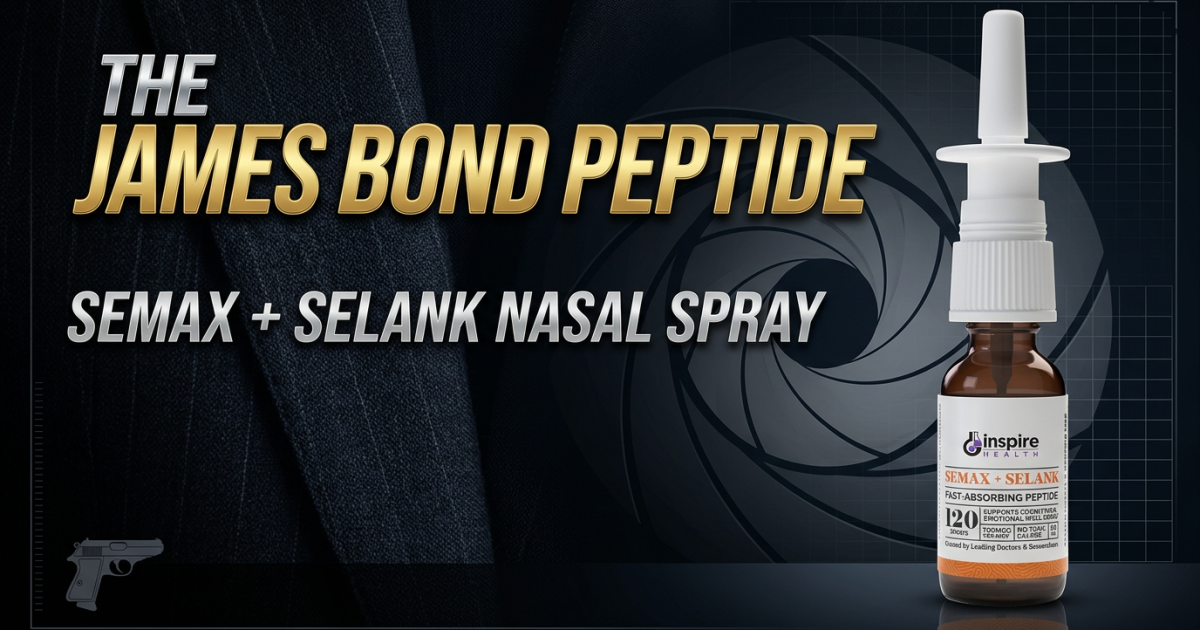
There’s a reason biohackers call the Semax and Selank combination the “James Bond Stack.” It’s the peptide protocol that delivers what every high-performer wants: razor-sharp focus, calm confidence under pressure, and mental clarity that doesn’t come with the jitters, crashes, or dependency of stimulants.
Bond doesn’t panic. He thinks three moves ahead. He’s composed in chaos. That’s exactly what Semax and Selank are designed to do at the neurochemical level — one sharpens cognitive output, the other eliminates the anxiety that dulls it.
But is the hype backed by science? Let’s look at what the research actually says.
What Is Semax?
Semax is a synthetic peptide derived from adrenocorticotropic hormone (ACTH), specifically the ACTH(4-10) fragment. It was originally developed at the Institute of Molecular Genetics of the Russian Academy of Sciences in the 1980s and has been used clinically in Russia since 1994 as a prescription medication for stroke recovery, cognitive disorders, and optic nerve disease.
Unlike most nootropics that target a single neurotransmitter system, Semax has a remarkably broad mechanism of action. Research demonstrates that it modulates multiple neurochemical pathways simultaneously.
How Semax Works in the Brain
BDNF Upregulation: Semax has been shown to increase expression of brain-derived neurotrophic factor (BDNF) and its receptor TrkB in the rat hippocampus and cortex. BDNF is often called “fertilizer for the brain” — it supports the survival of existing neurons and encourages the growth of new neurons and synapses. Higher BDNF levels are consistently associated with improved learning, memory consolidation, and cognitive flexibility.[1]
Dopamine and Serotonin Modulation: Studies have demonstrated that Semax influences the dopaminergic and serotonergic systems. Research published in Doklady Biological Sciences found that Semax administration led to significant changes in the expression of genes involved in dopamine metabolism in the rat brain, including tyrosine hydroxylase — the rate-limiting enzyme in dopamine synthesis.[2]
Neuroprotection: In models of cerebral ischemia (stroke), Semax has demonstrated significant neuroprotective properties. A 2006 study found that the peptide reduced infarct volume and improved neurological outcomes when administered during acute ischemic stroke. This neuroprotective effect appears to involve both anti-inflammatory mechanisms and stabilization of the blood-brain barrier.[3]
NGF Expression: Semax has also been shown to increase nerve growth factor (NGF) expression. NGF is critical for the maintenance and survival of cholinergic neurons in the basal forebrain — the same neurons that degenerate in Alzheimer’s disease and are essential for attention and memory.[4]
What Is Selank?
Selank is a synthetic analog of the naturally occurring immunomodulatory peptide tuftsin, with an added Pro-Gly-Pro sequence that improves metabolic stability. Like Semax, it was developed at the Institute of Molecular Genetics and has been approved in Russia as an anxiolytic (anti-anxiety) medication.
Where Semax accelerates cognitive processing, Selank removes the friction. Anxiety, worry, and mental noise are the enemies of clear thinking — and Selank targets them at the neurochemical level without the sedation or cognitive impairment of benzodiazepines.
How Selank Works in the Brain
GABAergic Modulation: Selank has been shown to influence the GABAergic system — the brain’s primary inhibitory network. Research indicates it enhances the sensitivity of GABA receptors without directly binding to the benzodiazepine site, which may explain why it reduces anxiety without causing sedation, tolerance, or dependence.[5]
Serotonin Metabolism: A study published in the Bulletin of Experimental Biology and Medicine found that Selank significantly affected the metabolism of serotonin in the brain, specifically altering the expression of enzymes involved in serotonin synthesis and degradation. This suggests a mechanism for its mood-stabilizing effects that operates independently of SSRIs.[6]
Immune System Regulation: As a tuftsin analog, Selank also has documented immunomodulatory properties. Research has shown it can influence the expression of interleukin-6 and affect the balance of T-helper cell subtypes. While this might seem unrelated to cognition, neuroinflammation is increasingly recognized as a contributor to brain fog, anxiety, and cognitive decline.[7]
Enkephalin Stabilization: Selank has been shown to inhibit enzymes that break down enkephalins — the body’s natural “feel-good” peptides. By preserving enkephalin levels, Selank may promote a calm, positive mental state without euphoria or impairment.[8]
Why They Work Better Together: The James Bond Stack
The genius of combining Semax and Selank isn’t just additive — it’s synergistic. Here’s why the combination produces something neither peptide achieves alone:
Semax without Selank can, in some individuals, produce a hyperfocused state that tips into overstimulation or task-switching difficulty. The dopaminergic drive is there, but without GABAergic balance, it can feel “edgy.”
Selank without Semax provides calm and reduced anxiety, but doesn’t necessarily enhance the raw cognitive processing speed and focus that high-performance situations demand.
Together, you get the full picture: heightened focus and processing speed (Semax) combined with emotional steadiness and anxiety elimination (Selank). The result is a state of calm performance — exactly the kind of composed, razor-sharp mental state you’d associate with a fictional spy who defuses bombs while adjusting his cufflinks.
This is why the biohacking community named it the James Bond Stack. It’s not about being wired. It’s about being unshakeable.
Nasal Delivery: Why It Matters
Both Semax and Selank are peptides — short chains of amino acids that would be destroyed by digestive enzymes if taken orally. Nasal administration solves this problem elegantly.
The nasal mucosa provides direct access to the bloodstream and, importantly, offers a pathway to the central nervous system via the olfactory and trigeminal nerve pathways. Research on intranasal peptide delivery has demonstrated that nasally administered peptides can reach the brain within minutes, bypassing the blood-brain barrier to some degree through these neural pathways.[9]
This is why nasal sprays have become the preferred delivery method for these peptides — rapid onset, high bioavailability, and direct CNS access.
What to Expect
Based on the published research and the pharmacological profiles of both peptides, here’s what the science supports:
Onset: Most users report effects within 15-30 minutes of nasal administration, which is consistent with the pharmacokinetic data on intranasal peptide absorption.
Duration: The cognitive effects of Semax are generally reported to last 4-6 hours, with Selank’s anxiolytic effects persisting for a similar timeframe. The combination provides a sustained window of enhanced performance.
What it feels like: Commonly described as “quiet focus” — the mental chatter quiets down, task initiation becomes effortless, and there’s a noticeable absence of the anxiety or tension that often accompanies intense cognitive work.
What it doesn’t feel like: This is not a stimulant. There’s no rush, no euphoria, no crash. If anything, the experience is notable for what’s absent — the usual mental friction, the background hum of stress, the difficulty staying on task.
Who Uses the James Bond Stack?
The Semax + Selank combination has found adoption across several high-performance communities:
Entrepreneurs and executives who need sustained focus during long workdays without the afternoon crash that comes with caffeine or prescription stimulants.
Students and researchers preparing for exams or working through complex material that demands both comprehension and retention.
Athletes who recognize that cognitive performance — reaction time, decision-making under fatigue, composure during competition — is as important as physical conditioning.
Creative professionals who find that anxiety and self-criticism are the biggest obstacles to producing their best work.
Safety Profile
Both Semax and Selank have been studied extensively in Russia, where they’ve been used clinically for decades. The published safety data is reassuring:
Semax has been administered to thousands of patients in clinical settings for stroke recovery and cognitive disorders. The most commonly reported side effects in clinical studies are mild and transient nasal irritation at the application site.[3]
Selank’s safety profile in clinical studies has been similarly favorable. Importantly, unlike benzodiazepines, Selank has not demonstrated dependence potential, withdrawal symptoms, or cognitive impairment in the published research.[5]
As with any bioactive compound, individual responses may vary. It is always advisable to consult with a healthcare professional before beginning any new supplementation regimen.
The Bottom Line
The James Bond Stack isn’t marketing hype — it’s a research-backed combination of two neuropeptides with decades of clinical use behind them. Semax brings the focus, processing speed, and neuroplasticity support. Selank brings the calm, the anxiety relief, and the emotional steadiness. Together, they create a state of composed, high-level cognitive performance that stimulants simply can’t replicate.
The question isn’t whether the science supports it. It does. The question is whether you’re ready to upgrade your mental operating system.
References
- Dolotov OV, et al. “Semax, an ACTH(4-10) analogue with nootropic properties, activates BDNF and trkB gene expression in the rat hippocampus.” Brain Research. 2006;1117(1):54-60.
- Shadrina MI, et al. “Expression of genes involved in dopamine synthesis and metabolism in rat striatum after administration of semax.” Doklady Biological Sciences. 2010;433:279-281.
- Gusev EI, et al. “Neuroprotective effects of semax in acute cerebral ischaemia.” Zhurnal Nevrologii i Psikhiatrii imeni S.S. Korsakova. 2006;106(2):26-30.
- Agapova TY, et al. “Effect of semax on the expression of the nerve growth factor and its receptor genes in rat hippocampus.” Doklady Biological Sciences. 2008;422:310-312.
- Zozulya AA, et al. “The inhibitory effect of Selank on enkephalin-degrading enzymes as a possible mechanism of its anxiolytic activity.” Bulletin of Experimental Biology and Medicine. 2001;131(4):315-317.
- Semenova TP, et al. “Selank and its metabolite affect serotonin metabolism in the rat brain.” Bulletin of Experimental Biology and Medicine. 2009;148(2):262-264.
- Uchakina ON, et al. “Immunomodulatory effects of selank in patients with anxiety-asthenic disorders.” Zhurnal Nevrologii i Psikhiatrii imeni S.S. Korsakova. 2008;108(5):71-75.
- Kozlovskaya MM, et al. “The anxiolytic activity of the synthetic peptide selank.” Zhurnal Vysshei Nervnoi Deyatelnosti imeni I.P. Pavlova. 2003;53(2):284-289.
- Dhuria SV, et al. “Intranasal delivery to the central nervous system: Mechanisms and experimental considerations.” Journal of Pharmaceutical Sciences. 2010;99(4):1654-1673.