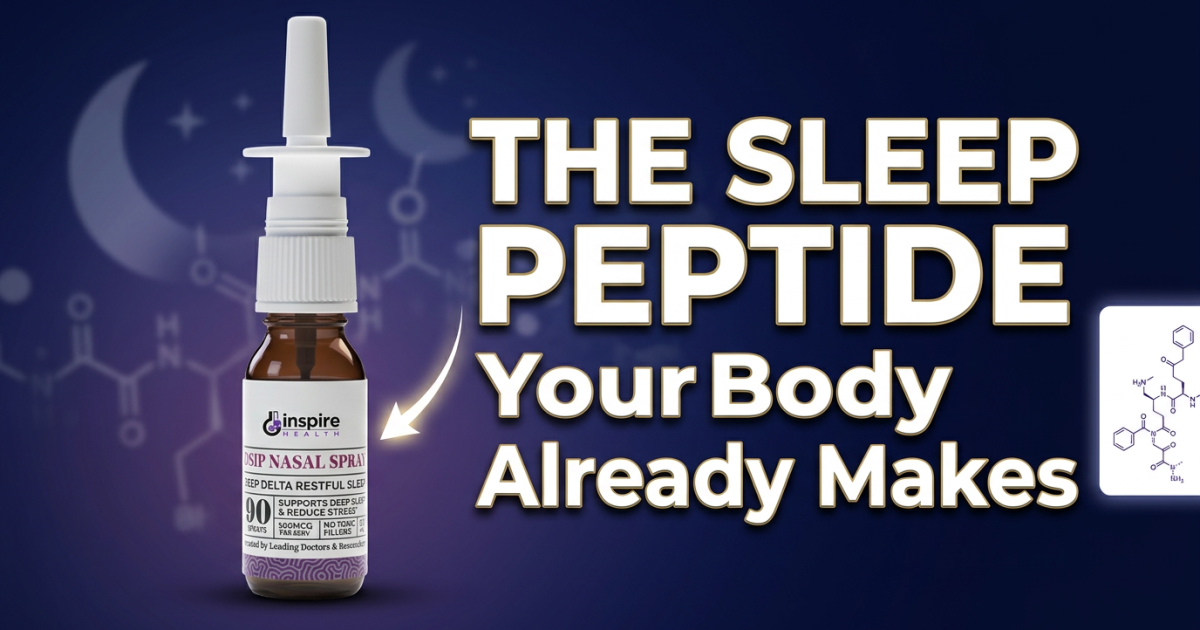
You’ve tried melatonin. You’ve tried magnesium. You’ve tried every “sleepy time” tea on the shelf. But what if the answer to better sleep wasn’t adding something foreign to your body — but restoring something your body already produces?
Delta Sleep Inducing Peptide — DSIP — is a naturally occurring neuropeptide first isolated from rabbit brain tissue in 1977 by Swiss researchers. It’s one of the few peptides directly named for its primary function: inducing delta wave sleep, the deepest and most restorative phase of the sleep cycle.
What Is DSIP?
DSIP is a nine-amino-acid neuropeptide (Trp-Ala-Gly-Gly-Asp-Ala-Ser-Gly-Glu) that crosses the blood-brain barrier and modulates sleep architecture at the neurochemical level. Unlike sedatives that force unconsciousness, DSIP appears to work by normalizing disturbed sleep patterns and promoting the natural progression into deep sleep stages.[1]
It was first described by Schoenenberger and Monnier, who demonstrated that transferring cerebrospinal fluid from sleeping rabbits to waking rabbits induced delta-wave EEG patterns — the electrical signature of deep, restorative sleep.[2]
How DSIP Works
Sleep Architecture Regulation: DSIP doesn’t simply “knock you out.” Research indicates it modulates the ratio of sleep stages, specifically promoting slow-wave sleep (stages 3 and 4) — the phases responsible for physical restoration, growth hormone release, immune function, and memory consolidation. A study in European Journal of Pharmacology found that DSIP administration increased delta wave activity without suppressing REM sleep.[3]
Stress Hormone Modulation: DSIP has been shown to influence the hypothalamic-pituitary-adrenal (HPA) axis. Research demonstrates it can modulate cortisol and ACTH levels, suggesting a mechanism by which it helps the body transition from a stress-activated state to a recovery state at night. Elevated evening cortisol is one of the most common causes of sleep-onset insomnia.[4]
Endorphin System Interaction: Studies have found that DSIP interacts with the endogenous opioid system, specifically influencing met-enkephalin levels. This may contribute to its pain-modulating properties and its ability to promote a calm, comfortable state conducive to sleep onset.[5]
Circadian Rhythm Support: Research suggests DSIP has chronobiotic properties — meaning it may help synchronize the body’s internal clock. This is particularly relevant for individuals with disrupted circadian rhythms due to shift work, travel, or irregular schedules.[6]
What the Clinical Research Shows
Clinical studies on DSIP in humans, while limited compared to pharmaceutical sleep aids, have shown promising results. A study involving patients with chronic insomnia found that DSIP administration improved sleep onset latency and increased time spent in deep sleep stages without the next-day grogginess associated with benzodiazepines and Z-drugs.[7]
Another study examined DSIP in patients experiencing sleep disturbances related to chronic pain. Researchers found improvements in both sleep quality metrics and subjective pain scores, suggesting a dual mechanism of benefit.[5]
Importantly, DSIP has not demonstrated tolerance development, dependence, or withdrawal effects in the published literature — a significant advantage over conventional sleep medications.
Nasal Delivery for Sleep Peptides
As a peptide, DSIP would be degraded by digestive enzymes if taken orally. Nasal administration provides direct access to the central nervous system via olfactory nerve pathways, with research showing rapid onset of effects — typically within 15-30 minutes, aligning well with a pre-sleep routine.
Who Benefits Most from DSIP
Based on the research, DSIP may be particularly relevant for individuals experiencing difficulty falling asleep due to an overactive stress response (high evening cortisol), light or fragmented sleep with insufficient time in deep sleep stages, sleep disruption from shift work or travel, or age-related decline in sleep quality (deep sleep naturally decreases with age).
Safety Profile
DSIP has been studied in clinical settings since the late 1970s. The published safety data shows a favorable profile with no reported cases of dependence, tolerance, or significant adverse effects. The most commonly noted side effect is mild transient drowsiness, which is arguably the intended effect.[7]
The Bottom Line
DSIP represents a fundamentally different approach to sleep support. Rather than sedating the brain, it works with the body’s existing sleep-regulation systems to promote the deep, restorative sleep stages that most people are missing. For anyone who’s exhausted by poor sleep but wary of pharmaceutical sleep aids, the research on DSIP offers a compelling alternative.
References
- Graf MV, Kastin AJ. “Delta sleep-inducing peptide (DSIP): a review.” Neuroscience & Biobehavioral Reviews. 1984;8(1):83-93.
- Schoenenberger GA, Monnier M. “Characterization of a delta-electroencephalogram sleep-inducing peptide.” Proceedings of the National Academy of Sciences. 1977;74(3):1282-1286.
- Iyer KS, et al. “Delta sleep-inducing peptide and analogs: effects on sleep.” European Journal of Pharmacology. 1988;154(3):253-258.
- Sudakov KV, et al. “Delta sleep-inducing peptide sequelae: effect on ACTH and cortisol.” Peptides. 1995;16(7):1341-1343.
- Merskey H, et al. “The effect of DSIP on chronic pain and sleep.” Pain. 1985;22(Suppl 2):S235.
- Kovalzon VM. “Delta sleep-inducing peptide: thirty years of research.” Neurochemical Journal. 2007;1(4):275-282.
- Schneider-Helmert D, Schoenenberger GA. “Effects of DSIP in man: multifunctional psychophysiological properties besides induction of natural sleep.” Neuropsychobiology. 1983;9(4):197-206.